Food Processors Water Cooperative
FPWC, Inc. supplies treated water to the Timberville food manufacturing businesses and nearby residents and businesses in Broadway and Timberville.
Emergency Notices
If there is a need to notify our users of an emergency, information will be posted here.

Contact Information
Call the PlantPhone (540) 896-9161
Fax (540) 896-3792
Email info@fpwc.biz
Location
13923 Timber Way
Timberville VA 22853
Mailing Address
Post Office Box 338
Timberville VA 22853
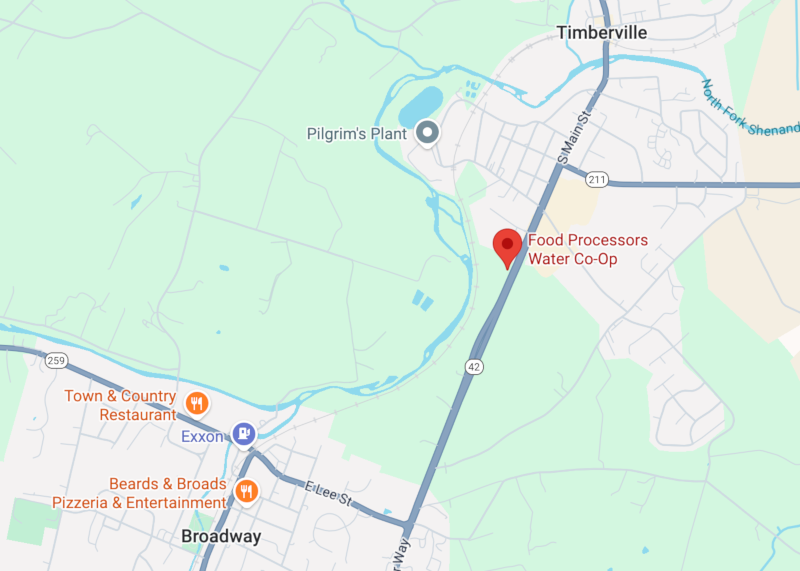
Click map for larger view Google Maps
Water Quality Report | 2025 | Page 1
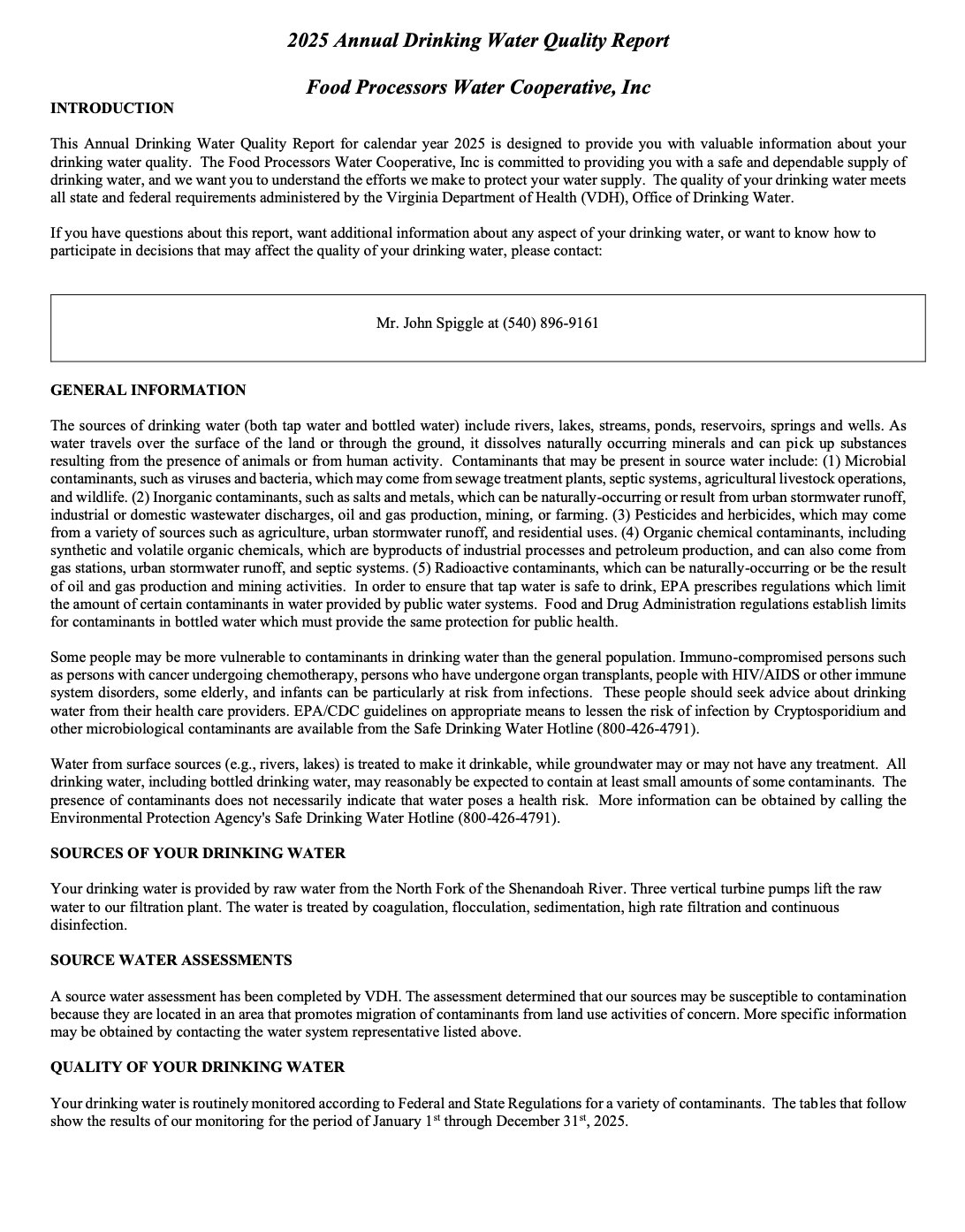
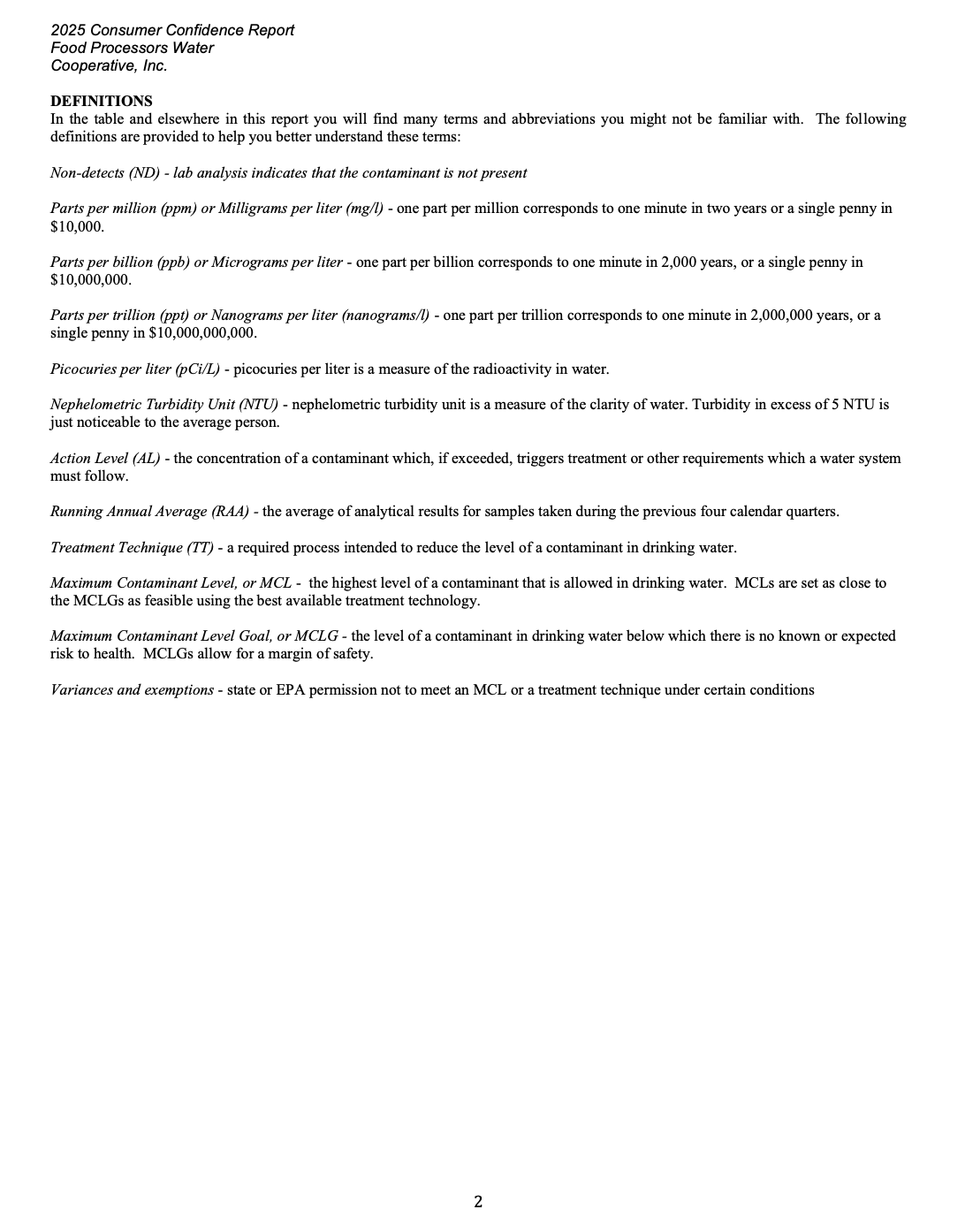
Water Quality Report | 2025 | Page 2
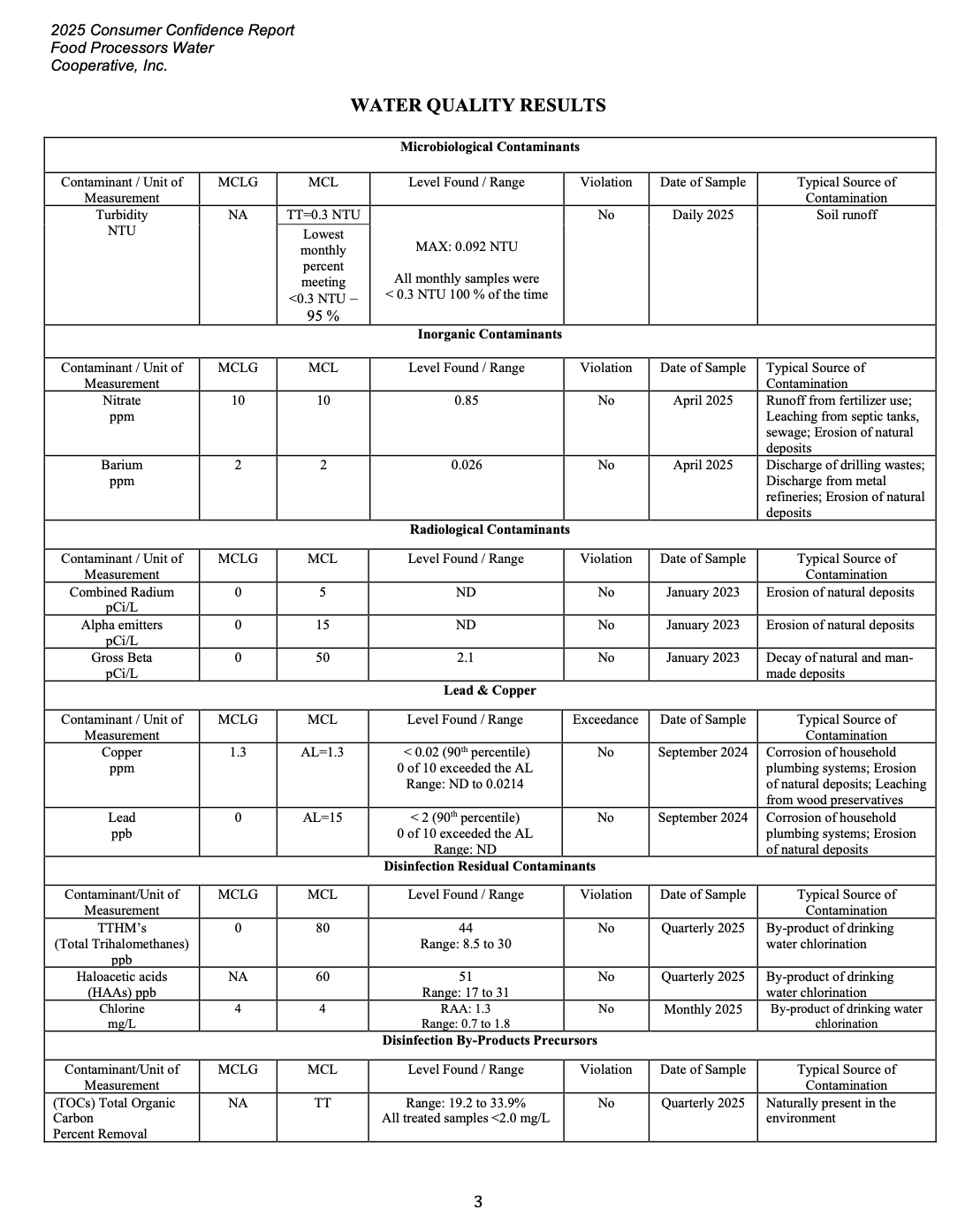
Water Quality Report | 2025 | Page 3
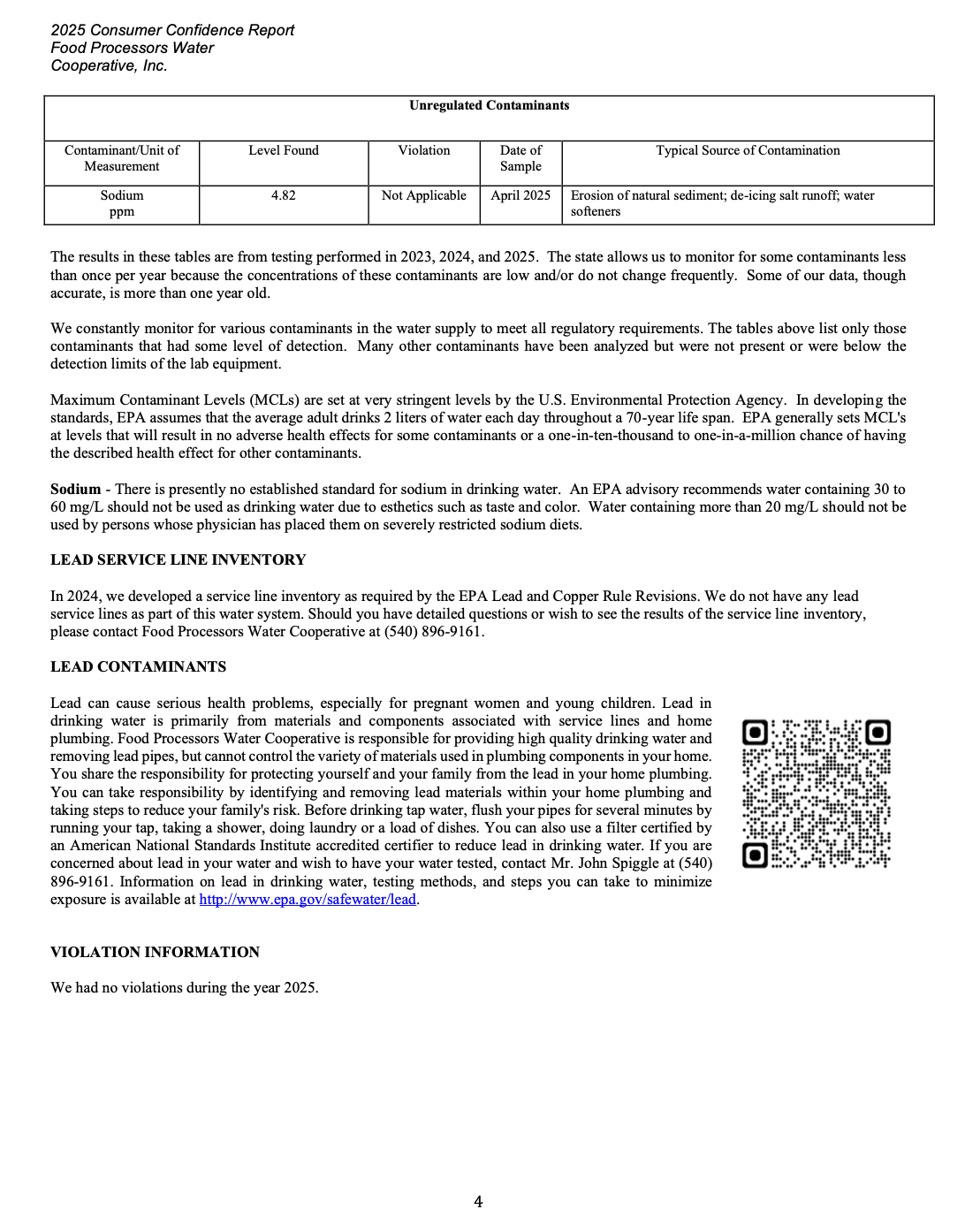
Water Quality Report | 2025 | Page 4
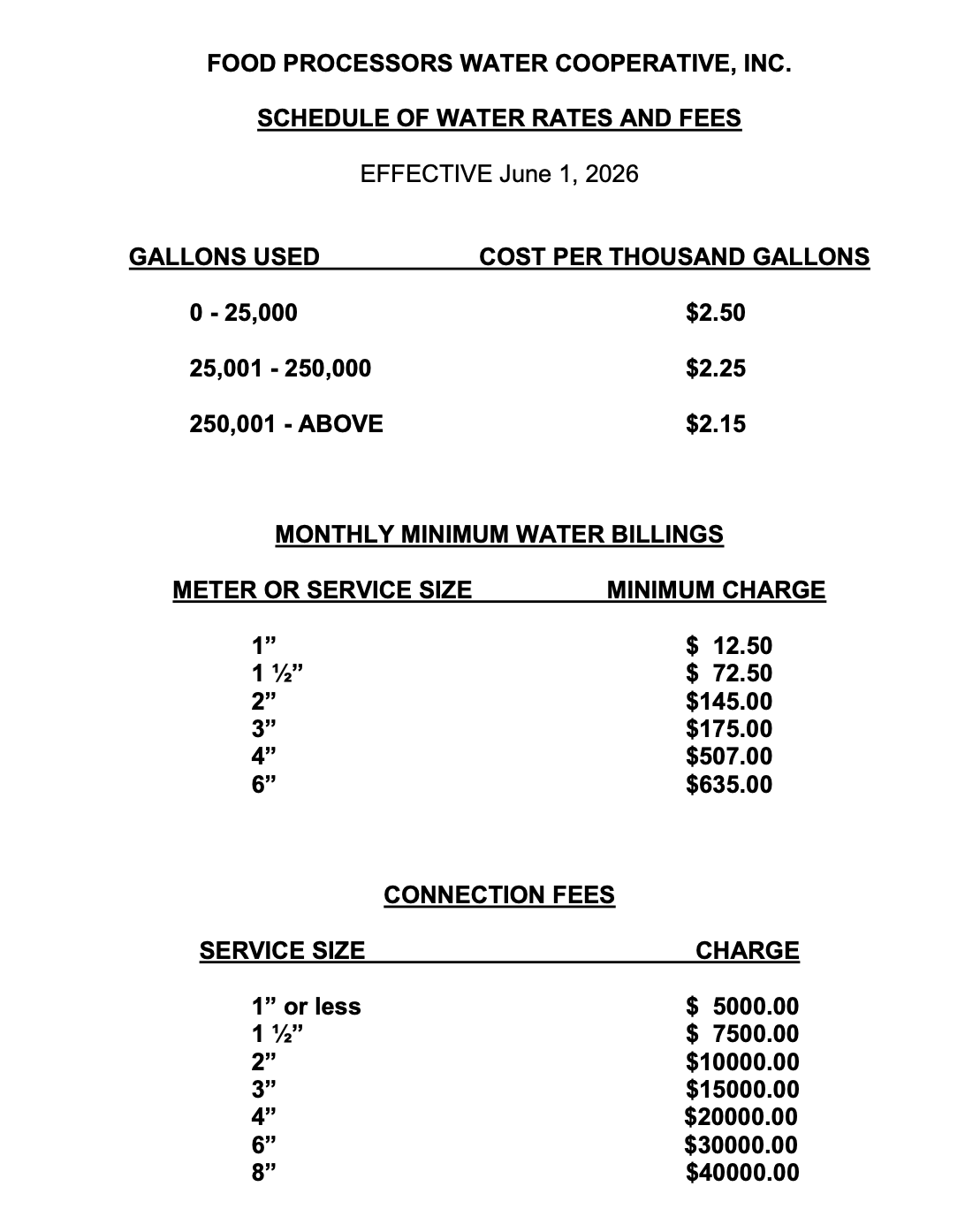
Current Schedule of Water Rates and Fees
About Us
Food Processors Water Cooperative, Inc. is a public water supply located in Timberville, Virginia. The plant incorporates the Roberts Filter Manhattan Process of High Rate filtration. Review the current water quality report.
With water from the North Fork of the Shenandoah River, treatment begins with disinfection to kill all diseases and harmful bacteria. Next steps are coagulation, flocculation, and sedimentation. The condition and clarity of the water is evaluated by certified personnel through laboratory testing. Operators determine the treatment chemicals needed and the respective dosages required to clean the water and make it safe to drink.
The final step in the treatment process involves filtration. Four mixed media filters produce the finished product at a rate of 1,360 gallons per minute. When the water meets standards set forth by the Virginia Department of Health, it is potable and safe to drink.
The finished water is collected and stored in three storage tanks with a total capacity of 3,300,000 gallons. The finished product is delivered to 28 bulk-use customers via an underground distribution system. Businesses and residents in the Broadway-Timberville area consume nearly 500,000,000 gallons annually.
In recognition, FPWC has received numerous awards from the Virginia Department of Health, Office of Water Programs, for Excellence in Operations. The five areas of excellence were for Cross-Connection Control Program, Financial Management, Water Quality Process Control, Distribution System Management, and Plant Staffing/Training.
Our History — 80 Years
FPWC, Inc. has operated since 1946 and is owned by Pilgrim's Pride Corporation and Cargill Meat Solutions. Since the beginning, the water cooperative has been a reliable source of potable water and has played a key role in the growth and stability of local businesses and the Towns of Broadway and Timberville.
Food Processors Water Cooperative began with four customers, one employee, 300,000 gallons of storage, 4,428 feet of distribution lines, and a treatment plant with the capacity to treat 500,000 gallons per day.
With water from the North Fork of the Shenandoah, FPWC is the second oldest High Rate water treatment plant in Virginia. Employing the Roberts Filter Manhattan Process, the facility provides drinking water of an exceptional quality.
In addition to providing water to the owners, Pilgrim's and Cargill, Food Processors Water Cooperative sells water to bulk-use customers including businesses and the Towns of Broadway and Timberville.
As demand for services increased, the size of the facility increased. Currently, Food Processors Water Cooperative has 28 customers, seven employees, 3,300,000 gallons of storage, 13,239 feet of distribution lines, and a treatment capacity of 2,000,000 gallons per day. Annual water sales are nearly 500 million gallons.
Protect Your Health
Lead is a common metal that has been in many consumer products but is now known to be harmful to human health if ingested or inhaled. It can be found in lead-based paint, air, soil, household dust, food, some types of pottery, and drinking water. Lead is rarely found in natural sources of water such as rivers, lakes, wells or springs.
What Are The Health Effects of Lead?
When people come in contact with lead, it may enter their bodies and accumulate over time, resulting in damage to the brain and kidneys, and can interfere with the production of red blood cells that carry oxygen to all parts of your body. The greatest risk of lead exposure is to infants, young children, and pregnant women. Lead in water can be a special problem for infants, whose diets may be mostly liquids, such as baby formulas or concentrated juices mixed with water. Smaller bodies can absorb lead more rapidly than bigger ones, so amounts of lead that won’t hurt an adult can be very harmful to a child and scientists have linked the effects of lead on the brain with lowered IQ in children. During pregnancy, the child receives lead from the mother’s bones, which may affect brain development. Adults who drink this water over many years could develop kidney problems or high blood pressure.
What Are The Sources of Lead?
The primary sources of lead exposure for most children are deteriorating lead-based paint, lead-contaminated dust, and lead-contaminated residential soil. Exposure to lead is a significant health concern, especially for young children and infants whose growing bodies tend to absorb more lead than the average adult. If you are concerned about lead exposure, parents should ask their health care providers about testing children for high levels of lead in the blood.
What Can I Do To Reduce Exposure to Lead in Drinking Water?
Lead may work its way into drinking water after the water entered the distribution system and is on its way to consumers taps. This usually happens through the corrosion of materials containing lead in household plumbing. These materials include brass faucets, lead solder on copper pipes, lead pipes, or lead service lines connecting the water main to the inside plumbing. Lead pipes are no longer installed for service lines or in household plumbing and lead solder has been outlawed in Virginia since 1985.
There are several steps you can take to reduce your exposure to lead in drinking water. These include:
- Run your water to flush out lead. If water hasn’t been used for several hours, allow the water to run at the tap for 15-30 seconds or until it becomes cold or reaches a steady temperature before using it for drinking or cooking. This flushes lead-containing water from the pipes. The water you run from drinking water taps does not have to be wasted. You can use this water for cleaning purposes or for watering plants. You may want to keep a container of drinking water in your refrigerator, so you don’t have to run water every time you need it.
- Use cold water for cooking and preparing baby formula. Do not cook with or drink water from the hot water tap as lead dissolves more easily into hot water. Do not use water from the hot water tap to make baby formula.
- Do not boil water to remove lead. Boiling water will not reduce lead.
- Look for alternative sources or treatment of water. You may want to consider purchasing bottled water or a water filter. Read the package to be sure the filter is approved to reduce lead or contact the National Sanitation Foundation at 800-NSF-8010 or www.nsf.org for information on performance standards for water filters. If you choose to install a lead removal filter, be sure to maintain and replace a filter device in accordance with the manufacturer’s instructions to protect water quality.
- Get your child tested. Contact your local health department or healthcare provider to find out how you can get your child tested for lead if you are concerned about exposure.
- Identify if your plumbing fixtures contain lead. New brass faucets, fittings, and valves, including those advertised as “lead-free,” may contribute lead to drinking water. The law currently allows end-use brass fixtures, such as faucets, with up to 8% lead to be labeled as “lead free.” Visit the National Sanitation Foundation Web site at www.nsf.org to learn more about lead-containing plumbing fixtures.
For More Information
Call us at 540-896-9161. For more information on reducing lead exposure around your home and the health effects of lead, visit EPA's website at www.epa.gov/lead, call the National Lead Information Center at 800-424-LEAD, or contact your healthcare provider.